![support.png]](https://help.prevuehr.com/hs-fs/hubfs/support.png?height=40&name=support.png)
What is a Bell Curve?
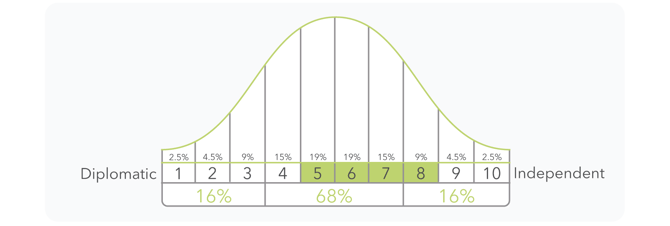
We use a bell curve to showcase the distribution of scores in the form of a graph. The term "bell curve" originates from the fact that the graph looks like a symmetrical bell-shaped curve. In a bell curve, the peak represents the most probable event in the dataset.
How it relates to candidate scores
The highest point on the curve, or the top of the bell, represents the most common score candidates achieve. Each section of the bell curve showcases the probability of a candidate receiving each score: 2.5% will score 1, 4.5% will score 2 and so on. The farther away from the peak or middle, the less common the score is.
How it represents to Prevue Benchmark
The Prevue Benchmark outlines the ideal characteristics for a specific role, shown as a shaded range of desired sten scores on each scale. Sten scores divide a scale into ten units, from 1 to 10, and are used in the Job-Fit Report to compare a candidate’s results against the benchmark.
Sample Benchmark Scale
In the example above for the Diplomatic vs. Independent scale, the shaded range of stens from 5 to 8 represents the benchmark. Scores within this range (5, 6, 7, or 8) are on the benchmark, while scores outside it (1, 2, 3, 4, 9, or 10) are off the benchmark.